


Temporary vs. Permanent: What Leagues Need to Know
- InProduction

- 21 hours ago
- 3 min read
For leagues, stadium infrastructure decisions are rarely just about buildings. They involve long-term commitments, public scrutiny, financial exposure, and competitive balance across markets.
The question leagues face today is not whether temporary or permanent infrastructure is better. It is when each approach supports broader league objectives, and when it introduces unnecessary risk.
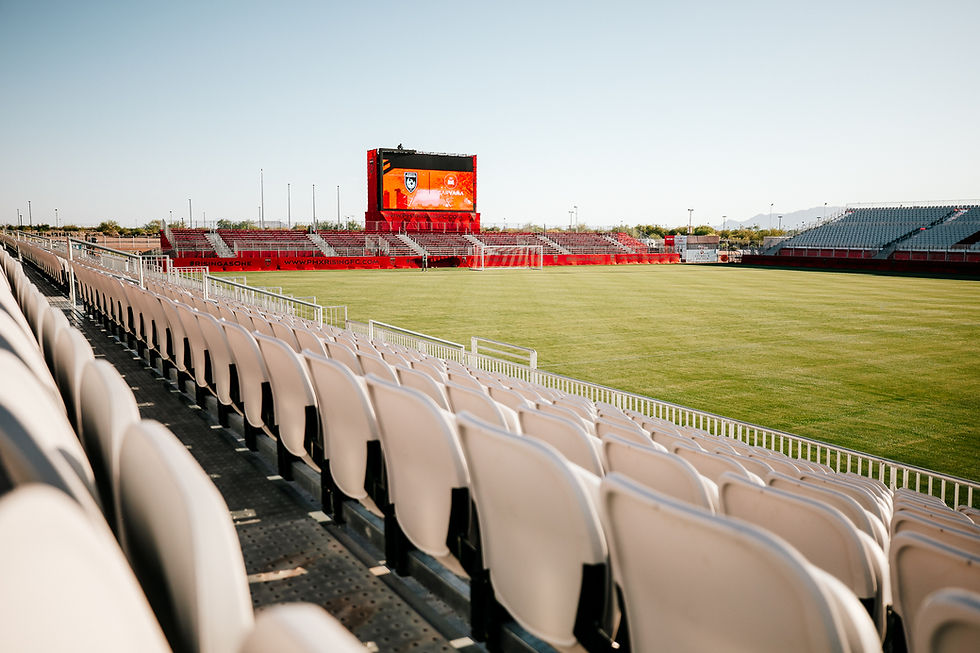
That distinction has become more important as the operating environment grows increasingly fluid.
Why This Question Is Surfacing Now
Leagues are navigating a level of variability that traditional planning models were not built to accommodate.
Expansion and relocation discussions remain active.
Public funding models face greater scrutiny.
Media, technology, and fan expectations continue to evolve faster than construction timelines.
Decisions that once felt generational are now being revisited mid-cycle. Infrastructure that cannot adapt creates friction at the league level, not just the venue level.
What Permanent Infrastructure Actually Commits a League To
Permanent stadium construction signals confidence and stability. It can be the right answer under the right conditions. But it also locks in a set of assumptions that extend well beyond the venue itself.
Those assumptions typically include:
Sustained long-term market demand
Consistent attendance patterns
Predictable revenue models
Stable, long-term relationships with host cities
When these conditions hold, permanent infrastructure performs well. When they shift,
leagues inherit the consequences, whether financial, political, or reputational.
Permanent infrastructure is not just a venue decision. It is a league-wide commitment.
Where Temporary Infrastructure Changes the Equation
Temporary and modular systems introduce optionality. Rather than replacing permanent construction, they allow leagues to stage decisions, adjust deployment, and respond to change without forcing early commitment.
This flexibility is especially valuable in situations such as:
Expansion markets still establishing demand
Neutral-site or rotating events
Renovation and transition periods
Cities testing long-term viability before committing capital
In these environments, temporary infrastructure gives leagues room to observe, evaluate, and adjust before locking in permanent outcomes.
The Risk Profile Leagues Often Overlook
Infrastructure risk is often framed around construction timelines and budgets. In practice, the greater exposure tends to emerge later.
Overbuilt venues that struggle to fill seats
Public backlash tied to underutilized facilities
Capital locked into assets that no longer align with league strategy
Temporary and modular approaches reduce the downside of being wrong. They preserve reversibility and allow leagues to recalibrate without forcing costly or public corrections.
Competitive Balance Across Markets
Leagues do not manage single venues. They manage ecosystems across multiple markets.
Disparities between markets affect:
Fan experience consistency
Revenue opportunities
Sponsor expectations
Broadcast presentation
Flexible infrastructure allows leagues to raise baseline standards without forcing every market into the same permanent solution.
Consistency does not require uniformity.
Fan Experience Is a League Standard, Not a Building Type
From the fan’s perspective, the distinction between temporary and permanent infrastructure is largely invisible.
What matters is whether the experience meets league expectations:
Clear sightlines and comfort
Safe, efficient access and circulation
Atmosphere that supports engagement and broadcast presentation
When designed intentionally and held to league standards, temporary infrastructure can perform on par with permanent construction.
Governance, Not Construction, Is the Real Issue
At the league level, infrastructure decisions intersect directly with governance.
Ownership groups change.
Municipal leadership shifts.Long-term agreements are revisited.
Temporary and modular systems provide flexibility without weakening standards.
They allow leagues to maintain control while accommodating local realities and evolving conditions.
This is not about avoiding commitment. It is about structuring commitment responsibly.
What Leagues Should Be Evaluating Now
Rather than framing decisions as temporary versus permanent, leagues benefit from asking more functional questions:
How reversible is this decision
How does this asset perform if assumptions change
How easily can this infrastructure evolve alongside the league
These questions lead to more durable outcomes than focusing on labels or construction types.
A More Nuanced Way Forward
Temporary and permanent infrastructure are not competing ideologies. They are complementary tools.
Leagues that understand when to deploy each are better positioned to manage growth, mitigate risk, and maintain consistent standards across markets.
The future of stadium planning at the league level is not about choosing sides. It is about building in options.


📩 Ready to see what temporary can do for your next event? Contact us at Info@InProduction.com.


